03 What we do · File No. 03
How we think about
product development
Our goal has always been to build products that are durable, useful, and beautiful, and to do it quickly and on budget while blending traditional craftsmanship with modern tools. Getting there took a workflow of our own.
- Steps
- Nine
- Basis
- Vitruvius, three principles
- Security
- Designed in, not bolted on
- IP
- Client owned
01 What good design owes you
Three principles, two thousand years old.
Our thoughts on good design have been greatly inspired by the timelessness and simplicity of the three key principles Vitruvius set out for good architecture.
-
Firmatis
Durability
It must stand up robustly and remain in good condition.
-
Utilitas
Utility
It should be useful and function well for the people using it.
-
Venustatis
Beauty
It should delight people and raise their spirits.
02 Why we built our own workflow
Every existing paradigm broke somewhere.
We have spent years considering agile development, SCRUM, lean manufacturing, Six Sigma, human-centered design, design thinking, and chaos engineering. Some firms treat these like religions and others dismiss them as buzzwords. Our struggles with them were specific.
-
Q1
Agile and SCRUM are very software-centric. What about hardware products?
-
Q2
Traditional systems engineering added a lot of non-value-added work. Great for large systems maintained for 25 to 100 years. What about products that have to get to market fast?
-
Q3
Six Sigma was great for large companies where the benefits outweighed the overhead. What about small and nimble start-ups?
-
Q4
Our team is geographically dispersed, so paper-driven processes will not work. Can we be completely digital for engineering, project management, and customer support?
-
Q5
Security always seems like an afterthought. How can we bake security into the product design process?
-
Q6
We respect that we only have this one planet. What are the impacts of the product at the end of its design life? Can it be recycled or disposed of safely?
So we developed a workflow of our own, taking the best ideas from the legacy paradigms and modernizing them for digital-only design and fabrication.
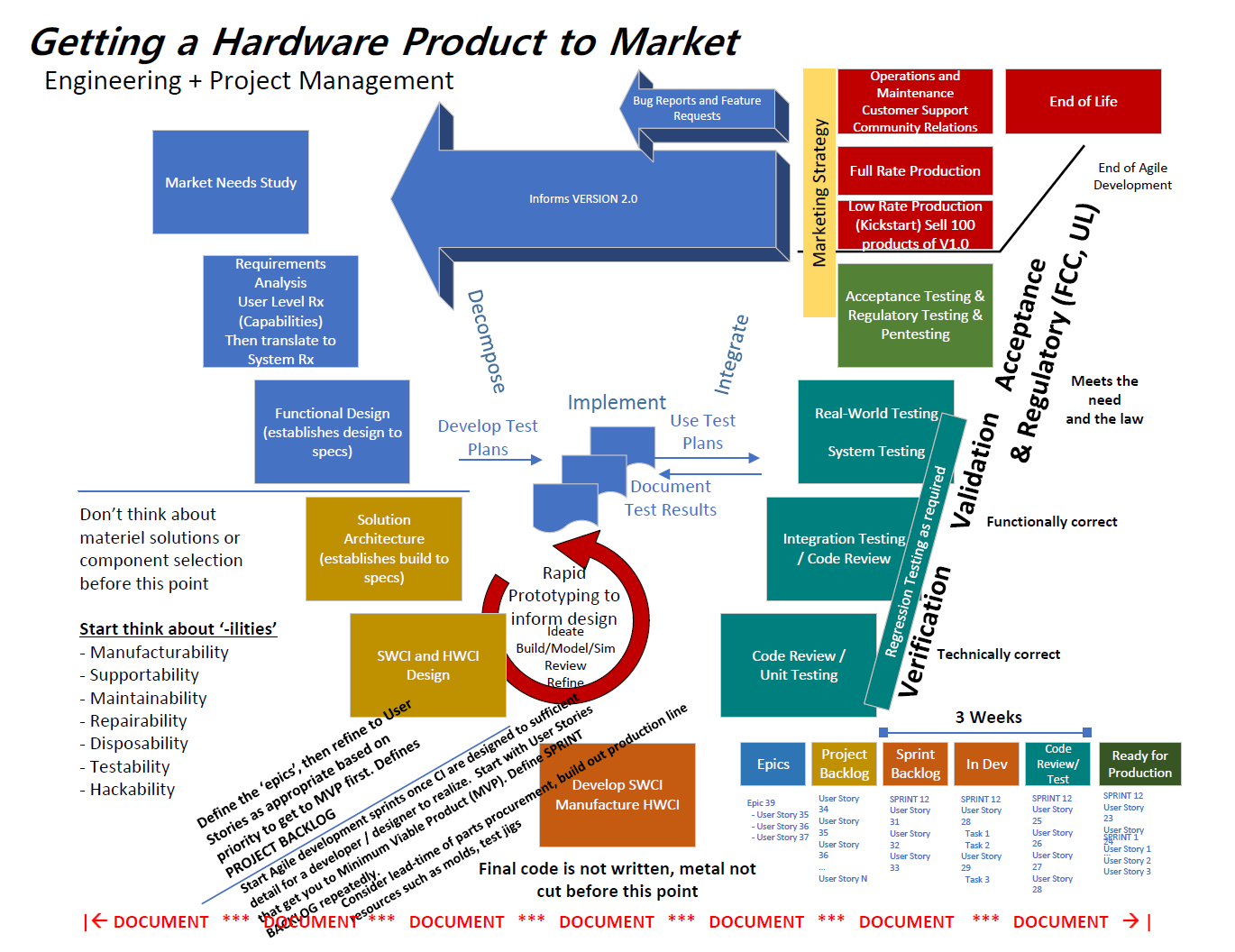
03 Our secret sauce design flow
Nine steps, from the napkin to the manufacturing package.
-
01
Figuring out the problem to be solved
Requirements development and ideation. Identify use cases, identify constraints, run a rough order of magnitude cost and schedule analysis, and make a technology maturation determination.
-
02
Exploring potential solutions
Market studies, conceptual analysis and design, functional analysis, feasibility studies, rapid prototyping and mockups, and a top-level system architecture.
-
03
Refining the big picture
Proof of concept, form/fit/function prototypes, an iterative design and test loop, and short-duration builds. Finalize requirements, cost, schedule, architectural designs, and use cases.
-
04
Design the solution
Detailed design and engineering. Build the bill of materials, identify dependencies, generate documentation, develop testing, verification, and validation procedures, and refine the design to be manufacturable, sustainable, secure, and testable.
-
05
Build the solution
Leverage our in-house fab lab to manufacture as much as possible under this roof. We also work with global partners on assemblies and components that require more complex industrial tooling. Then final assembly of the looks-like and works-like prototype, plus the Design for Manufacturing package: BOM and CAD.
-
06
Test the tech
Unit testing and integration testing. Verification of technology, design, and engineering, and validation of the failure modes analysis.
-
07
Test the product
Validate the solution, user acceptance testing, and live testing in real-world environments, then system optimization based on the feedback.
-
08
Hack and harden
Assess any cyber and physical vulnerabilities that can potentially be exploited, then design and implement the solutions.
-
09
Prepare for manufacturing
Low-volume manufacturing to help refine the BOM, cost of goods sold, MCAD and ECAD packages, and source code. Finally, we can put you in contact with industry-leading manufacturing partners if mass production is the goal.
04 Success means thinking about the future
Building a prototype is one thing.
Building a product that can be sold requires more than a good idea. It requires planning for everything that turns a prototype into a product, so we think about manufacturing and assembly from the very beginning. These are the considerations we balance.
05 Empowering our clients
Our clients own their intellectual property.
We are big believers in open source, and we encourage clients to consider open-source licensing for their products. We also understand that the business model does not work for everyone. Either way, we take intellectual property rights seriously: our clients own their IP, and we retain none of it.
Every design gives you access to
- Feasibility studies, specifications, and evaluation reports
- Schematic, PCB, and Gerber files
- CAD design and fabrication files for all mechanical components
- Bill of materials
- Software and firmware source code
- Looks-like and works-like prototypes
- Project documentation and final assembly instructions
- Test plans and reports
- Video tutorials and professional product photography
- Technical and artistic illustrations
Ready when you are
Let's turn your idea into a tangible object.
Concept to delivered product. Mechanical, electronics, and software, built under one roof. Quickly and within budget.
Schedule a consultation